Mindful Living · Tea Spa Journal
Find Stillness in Your Own Way
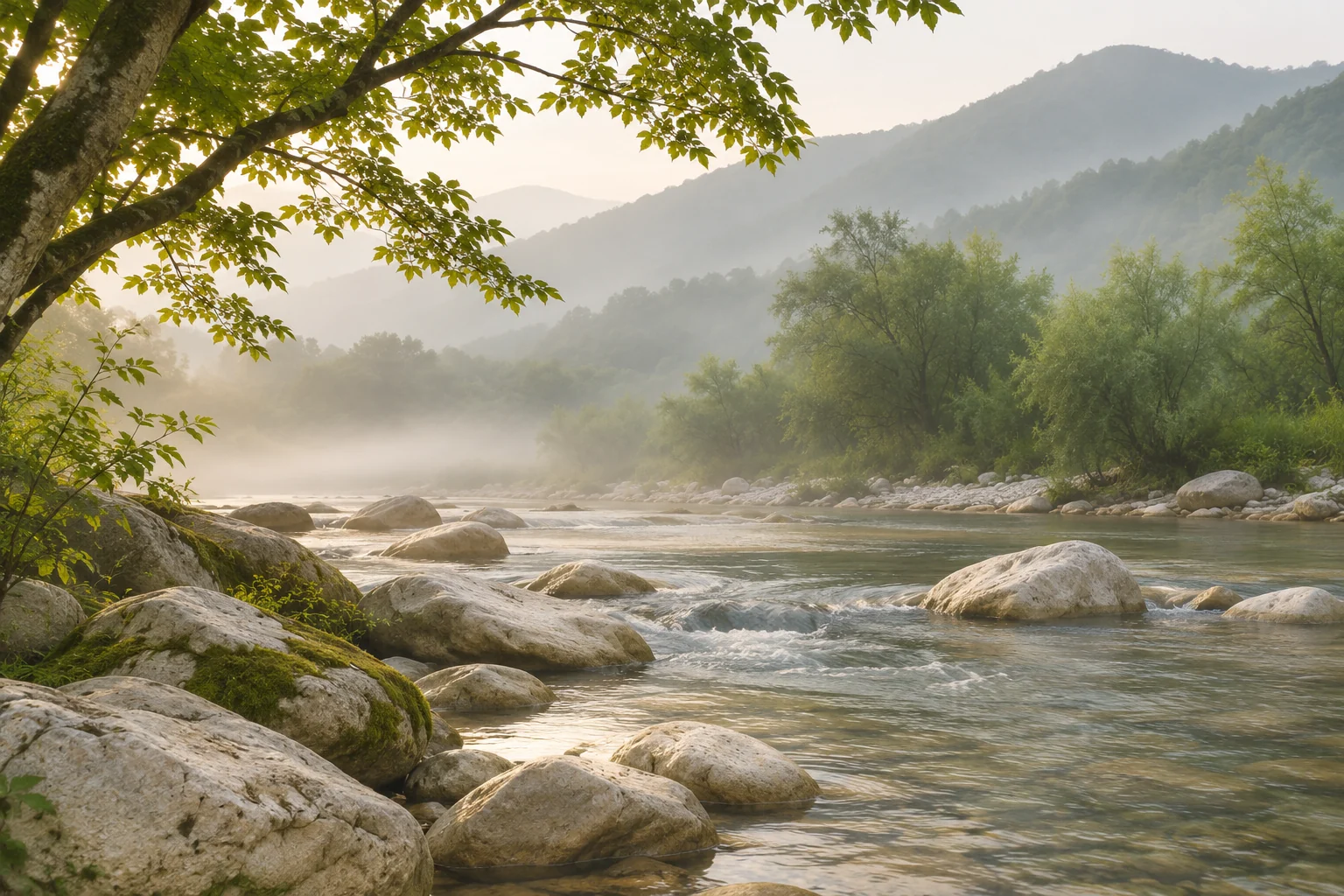
Imagine sitting beside a flowing river, surrounded by towering mountains, with birds singing somewhere in the distance. You can hear the gentle movement of water, the occasional rustling of leaves, and the soothing sounds of nature all around you.
Except you're not actually outdoors. You're sitting in your room, wearing a virtual reality headset. This is one of my favorite ways to experience meditation.
Some virtual reality programs offer guided sessions, with an instructor leading participants through breathing exercises or mindfulness techniques. I usually prefer the ones that require very little guidance.
Before the session begins, I'm given a few simple instructions on how to sit and breathe. Then, I'm left to enjoy the scenery and the sounds around me. There are no lengthy instructions or complicated rituals, just the flowing river, the mountains, the birds, and an opportunity to direct my attention toward something peaceful. I find the experience incredibly relaxing.
It raises an interesting question: If meditation can happen in a traditional meditation hall, a quiet room at home, or even a virtual landscape, what exactly makes something meditation?
What Is Meditation, Really?
For some people, the word meditation brings to mind someone sitting cross-legged, eyes closed, surrounded by candles or incense.
For others, it evokes images of monks, spiritual ceremonies, or religious traditions.
Those associations aren't entirely misplaced. Meditation has deep roots in several religious and philosophical traditions, including Buddhism, Hinduism, and other contemplative practices developed over centuries. However, meditation isn't a single activity with one universal purpose.
Broadly speaking, it involves practices that train or direct attention. Depending on the approach, someone might focus on their breathing, observe their thoughts, repeat a meaningful phrase, or cultivate qualities such as compassion.
Some practices are explicitly spiritual. Others are taught in secular settings, where the emphasis may be on attention, awareness, or stress management. And although meditation and relaxation sometimes overlap, they aren't necessarily the same thing.
Listening to soothing music or enjoying a beautiful landscape can be relaxing without being a formal meditation practice. Meditation generally involves some intentional way of working with attention or awareness.
That distinction helps explain why two people can sit quietly in the same room yet be doing very different things.
Does meditation have to be religious?
This is an important question, especially for people whose religious beliefs influence how they approach spiritual or contemplative practices.
For some, meditation is inseparable from faith. It may involve prayer, sacred teachings, spiritual reflection, or practices passed down through generations.
For others, meditation is primarily a secular exercise. Some people choose not to meditate because certain techniques conflict with their religious convictions.
These perspectives deserve respect.
The fact that meditation is sometimes taught outside religious settings doesn't erase its spiritual history. Likewise, its religious origins don't mean every modern meditation exercise requires someone to adopt a particular faith. What matters is understanding the practice rather than assuming that every activity described as meditation is identical.
Someone may feel comfortable with a simple breathing exercise but not with a practice involving spiritual chants. Another person may prefer prayer, reading scripture, or quiet contemplation. Exploring ways to focus the mind doesn't have to mean setting aside personal beliefs. And choosing not to participate in a particular form of meditation is just as valid as choosing to explore it.
Guided, Unguided, and Everything in Between
One reason meditation can seem intimidating is that people often imagine there's only one correct way to do it.
But different techniques offer different experiences.
In guided meditation, an instructor may provide directions throughout the session. Participants might be invited to notice their breathing, pay attention to physical sensations, or visualize a particular setting. Unguided meditation involves practicing more independently, often with little or no spoken instruction.
Some people appreciate the structure of a guided session, especially when they're beginning. Others prefer fewer interruptions.
Technology has introduced additional ways to explore these approaches. Meditation or fitness apps can offer short audio sessions, while virtual reality programs can create immersive environments featuring forests, mountains, beaches, or rivers.
In my own VR sessions, the instructions are brief. Once I've settled into a comfortable position and begun breathing naturally, I can focus on the sights and sounds around me. The experience doesn't require me to imagine a peaceful landscape. I can look around and see one. Of course, virtual reality isn't necessary for meditation, and not everyone finds headsets comfortable or immersive environments enjoyable.
But technology offers an interesting reminder that the setting can change even when the underlying practice of directing attention remains familiar.
What does science say about meditation?
For centuries, people have practiced meditation for spiritual reflection, contemplation, and personal well-being. Today, scientists are also studying what happens when people meditate and whether certain techniques can support mental and physical health.
Researchers are studying how meditation and mindfulness may support well-being. The National Center for Complementary and Integrative Health (NCCIH), part of the National Institutes of Health, summarizes both promising findings and important limitations.
A 2018 analysis involving more than 12,000 participants with psychiatric diagnoses found that mindfulness-based approaches helped with anxiety and depression compared with no treatment, with results comparable to established therapies in that analysis. This does not mean every meditation practice is equivalent to clinical treatment.
For sleep, a 2019 analysis of 18 studies involving 1,654 participants found better sleep quality than education-based approaches, but no difference compared with evidence-based treatments such as cognitive behavioral therapy or exercise.
Studies vary in quality and in the practices they examine. These findings do not establish that a particular VR meditation program will produce the same results. Meditation can also bring unwanted experiences, including anxiety. It should not replace necessary medical or mental health care. If a practice feels distressing, it is reasonable to stop and seek appropriate support.
Research source: NCCIH: Meditation and Mindfulness—Effectiveness and Safety.
A Place for Meditation, Tea, and Connection
For those curious about exploring meditation in a welcoming community setting, Amata Meditation Center in Boyds, Maryland, offers an opportunity to experience contemplative practices in person.
Amata welcomes visitors for meditation, tea, art, and time in its peaceful surroundings.
Visitors can explore self-guided meditation or participate in scheduled group sessions. Those who are simply curious about the space can also enjoy tea, conversation, and the center's natural and architectural surroundings.
Amata welcomes people from different faiths and backgrounds, including those with no religious affiliation. At the same time, some of its formal retreats are rooted in specific Buddhist meditation traditions, so visitors are encouraged to learn about individual programs and decide what aligns with their interests and beliefs.
There is no need to arrive as an experienced meditator. Sometimes, curiosity begins with a conversation over a cup of tea. Tea Spa and Amata are separate organizations; Amata activities are not included in Tea Spa memberships.
Finding Your Own Way
My virtual reality experience looks quite different from meditation as it has been practiced in traditional settings for centuries.
There are no mountains outside my window, no actual river flowing beside me, and no birds perched in nearby trees. Yet the experience has helped me discover a way of directing my attention that I genuinely enjoy.
Someone else might prefer guided meditation, a quiet meditation hall, or a contemplative practice grounded in their faith. Another person might find that prayer, spending time in nature, or sitting peacefully with a cup of tea better suits their needs.
These activities aren't all the same, and they don't have to be. Perhaps the most valuable lesson isn't that everyone should meditate, but that there is more than one way to explore attention, reflection, and calm.
At Tea Spa Wellness, Sharing Inner Peace is an invitation to recognize that well-being can be experienced in different ways. Sometimes, discovering what works for you begins with something as simple as being curious enough to try.
Curious about Amata Meditation Center?
Located in Boyds, Maryland, Amata welcomes visitors for meditation, tea, and quiet reflection. Admission is free, and no prior meditation experience is required for regular visits.
Learn more about regular visiting hours and available activities on our meditation center page. Check individual retreat information separately before planning a retreat visit.